Search This Blog

Showing posts with label wine. Show all posts

Tuesday, June 6, 2017

Tips for Throwing an Awesome Wine and Cheese Party


Here's another previously published post from that now defunct web site...


Planning a Wine and Cheese Tasting Party at Home

Wine and cheese are natural companions and planning a party around a wine tasting theme is a great way to learn how certain foods compliment certain wines. It is also a good excuse for gathering a group of people together to uncork a few of your favorite bottles or even to experiment a bit and try something new.

Select what wines to choose by deciding what kind of experience you want your guests to have. Will you stick to old favorites? Will you try to learn about "new" varietals you haven't tried before? Will you compare specific varietals of old world wines to their new world counterparts? Do you want to introduce your guests to wines they can enjoy socially without the need of food? How many different types will you serve? (The standard is between four and six different wines.)

If you are not an expert in wine varietals and vintages you will want to make a list of all the things you like and dislike in a wine being sure to be as specific as possible. Once you have decided on your wine and cheese party theme you can take your list to your favorite retailer and explain what you like and what you want to accomplish with your tasting and come up with a list to delight the palates of you and your guests.

How much wine to purchase for your party will depend upon how many guests you are inviting. You can get ten to twelve "tastes" from a bottle of wine depending on pour size so you will want to have at least two bottles of wine for every dozen or so people expected. This way there will be ample enough wine to go around and guests will be able to revisit the wines they liked later.

If you will have not tried the wines before the party be sure to find out if any need to be decanted before serving. This is extremely important because if a wine needs to be decanted for an hour you will have to open it well ahead of your guests' arrival for it to have oxidized appropriately for enjoyment. (Experimenting with oxidation is another good idea for a wine party theme.

The wine seller can also help you choose the proper order in which for your wines to be arranged for tasting. You will not want to skip back and forth at random as some wines will not compliment each other or may be heavier or more or less refreshing than others. Wine tasting usually begins with bubbles such as Champagne, Cava, or Prosecco. Even if you are not including some type of sparkling wine in your tasting lineup it is a good idea to have a few bottles on hand and chilled for your guests to enjoy a glass upon arrival while waiting for the tasting to begin.

Tasting order should be white wines first, then reds, and then dessert wines. You could also finish with a nice sherry or liqueur or even a bit of Pineau de Charentes. Be sure to serve your wines at the proper temperatures for optimum enjoyment. If a wine is too cold it will not offer up any bouquet and will have very little to offer in flavor as well. If a wine is too warm it may feel too acidic or tannic on the tongue. Even red wine varietals could stand a few minutes in the fridge to cool off as room temperature can vary in different parts of the world.

You may have to do a little research in order to choose complimentary cheeses for the wines you have picked for your tasting party. Try to select quality artisan cheeses if possible instead of mass produced cheese that is readily available at the supermarket. Whenever possible, look to cheeses that are from the same regions as the wines you have chosen for your party.

In addition to cheese you should provide your guests with crackers or bread such as a few sliced baguettes so that they can clean their palates in between tasting the different wines you have selected. Cheese is not necessarily a substantial support for wine drinking so consider having a few other food items for your guests such as a green salad and perhaps a bit of pasta. These additional food items will not only keep your guests from becoming tipsy, they will appreciate the opportunity to try the wines you have selected for your party with and without actual food as this can help them plan their own wine and food pairings in the future.

You will also want to have plenty of water on hand for both drinking and for rinsing of glasses. Rinsing a glass with water will insure that a particularly aromatic or pungent wine does not leave any left over influence in the glass to interfere with the experience of the next wine being tasted. It also saves you from having to perform a rinse with the next wine, which leaves more in the bottle for drinking.

Even though wine tasting portions are only an ounce or two, if your guests are lightweights they may not wish to actually drink all of the wines being tasted to a dump bucket (or two) might be hand to have on hand. A simple ice bucket will do for this purpose. This could be useful as well is a guest does not care for the taste of a particular wine and wants to pour it out.

Handing out fact sheets or tasting notes will give interested guests background information on the wines being tasted and help them to remember them later should they decide they would like to purchase them. Most tasting notes are available online from the winemakers and your favorite wine retailer can help you with this as well.

If you have decided you want your guests to come away from your wine and cheese party with an increased knowledge of wines you should provide them with a tasting sheet where they can record their impressions of the wine's color, smell and taste, as well as how it paired with the particular cheese you chose for it.

Smell, taste, and appearance are the three key factors in experiencing what a wine has to offer. Always have your guests taste their wines in an actual glass that is clear and free of cutwork designs. Plastic cups may save you a lot of dishwashing, but they just do not offer the same experience.

Wine tasting can be a delightful adventure for the sense and with a little planning you can throw and awesome wine and cheese party your guests will remember fondly for years into the future.

Monday, January 12, 2015

How to Remove Labels From Wine Bottles

Have you ever had a really good glass or bottle of wine and then when you wanted to have it again, you couldn't couldn't remember the name? One way to combat that bit of winesia is to collect the labels from bottles that you like.

These days you can easily take a photo of the wine label with your mobile phone, but let's face it, what are the chances you will even remember that you have the imaged stored in your phone later on? For most of us, once those images are posted to social media and a little time has passed. we forget we ever took most of the photos saved in our phones.

Removing the label from a wine bottle and saving it in a notebook or wine journal provides us with an opportunity to preserve the experience of drinking the wine as well, as we can make notes about the wine's bouquet, flavor notes, etc., to help remember not just that it was a palatable wine, but specifically why.

Below is an article on how to remove the labels from those lovely bottles of wine previously published in August of 2010 on the now defunct Helium web site.


How to Remove Labels from Wine Bottles


There are a few ways by which to remove wine labels from bottles from soaking in warm water to using commercial products designed for the task. Some methods are more effective than others depending upon the label itself and the adhesive used to affix it.
Most people remove wine labels the old fashioned way by soaking the bottles in hot water until the labels lift away. While this may work for some labels, with others it results in torn wet paper. If your aim is to simply remove the label and not to preserve it, this method may be perfectly fine for your needs.
Alternatively you can also put the bottle(s) in the dishwasher. Some people have found this method effective; though there is the chance the loosened label could cause a blockage or other issue inside the dishwasher.
The best way to remove a label from a wine bottle and preserve it is to use a commercial label lift sheet specifically for removing wine labels. To remove the label this way you simply peel the backing away from the sheet and carefully position it onto the bottle. You then burnish it against the label with the back of a spoon and let it sit for about twenty minutes.
Once time is up you should be able to peel up the label lift sheet and the surface of the label along with it. If the label face has not completely adhered to the sheet simply reposition it, burnish again and let it sit a bit longer.
This method preserves the labels for your favorite bottles but doesn’t leave the bottle completely clean. If you are planning on reusing the bottle and want the label completely gone you will still have to employ one of the other methods.
An effective and economical alternative to a commercial label lift product is to use clear packaging tape. Unlike the label lift sheet, the tape will not be wide enough to cover the entire label so you will have to use two or more strips of tape that slightly overlap each other.
Apply the tape to the wine label similarly as described above for the label lift product and burnish. After the tape has set (twenty-thirty minutes) carefully peel back the edge to see if the label is ready to be lifted. Unfortunately there are some labels that will not lift this way even if the tape is left on the bottle overnight.
Labels successfully removed via the tape method or the commercial label lifting product can be put into a wine journal for safe keeping or even added to a scrapbook to commemorate a special occasion.

Friday, December 12, 2014

How to Wrap a Gift Bottle of Wine in a Hurry

'Tis the season to be sipping! Okay, so that's pretty much every season when you're a wine lover, but when it's also the season of giving, wine lovers may feel even more compelled to share the pleasure of a good vintage with friends and family. After all, what's better than a gift of a good bottle of wine?

Wine is a great choice for a last minute gift when you've run out of time to shop, or have just run out of ideas for what to give someone. Let's face it, once you reach a certain point in life, you don't really need more stuff. When someone gives you a bottle of wine however, it takes up very little space, you consume it, you enjoy it, and you later remember it fondly.

These are all big wins, but best of all, you - or your gift recipient - won't get any unwanted clutter from a wine gift. The article below, originally published in January of 2011, details what to do when it's time to wrap that gift bottle of wine when you're pressed for time.


Emergency Wine Bottle Gift Wrap Solutions


A bottle of wine makes a great gift for just about any occasion. When it comes to presenting a gift bottle of wine, especially as a surprise, gift wrapping can present a bit of a challenge, however. If the wine is a last minute gift, wrapping can be particularly tricky.
In an emergency almost anything can be used to wrap a gift bottle of wine. A wine tote or even the bag it was placed in at the time of purchase can be used as gift wrapping. Figuring out what to use will depend on what is available at hand.
If you are in the supermarket buying a bottle of wine and there is a floral department, see about getting some of the floral tissue to wrap your bottle. If the market also sells balloons you can try and get some curling ribbon cut to tie around the neck of the bottle.
If you are buying the gift wine in a specialty store such that also carries table linens you can use a couple of dinner napkins to wrap the bottle. If nothing is available to use as a ribbon, ask the sales clerk for a rubber band or fold another napkin into a narrow strip and use it as a tie to hold the others in place.
If you have the bottle of wine already and you are at home, you can make your own gift wrap by recycling a large brown grocery bag or with plain old freezer paper from the kitchen. Draw lines or designs on the paper with a sharpie and you’ll have your own instant, custom gift wrap.
Depending on who the gift is for, you can use a reusable cloth item such as a ladies scarf, tea towel or even a small folded table cloth as emergency gift wrapping. This way the gift wrap is also a part of the gift. In a real pinch an extra large T-shirt could be turned into reusable cloth gift wrapping. Simply cut off the top under the sleeves and open the resulting tube to create a rectangle of fabric.
A tote bag can also be pressed into service as an emergency gift bag as long as it is not too large. Stuff plastic grocery bags around the wine bottle inside the tote the way you would use gift tissue in a paper gift bag.
Of course, if you often give wine as a gift, the best thing to do is to avoid an emergency all together by having a supply wine gift bags and tubes on hand in the first place. If that isn’t a viable option, or if you’ve just run out of wrapping supplies, one of these emergency solutions should work for you.

Friday, November 28, 2014

Malbec: The Other Red Wine

Wine tasting is by far one of my favorite pastimes. When I started contributing articles to Helium, I was thrilled to have the opportunity to be able to write about wine. I am far from an expert on the subject, but in the fall after hurricane Katrina (the following fall - 2006) I started attending tastings around town on a regular basis, and after the first year of sampling and note taking, I realized I had compiled quite a lot of information.

Before that time, I hadn't given much thought to all the range of wine varietals that exist. By the fall of the following year (2007) I had also taken over as the organizer of a Meetup.com based wine group. By the time I started contributing to Helium, I was ready to do quite a lot of wine writing, only I soon discovered that crafts and how-to articles were a lot more profitable.

I don't go out to taste quite as much anymore, but with Helium soon to be no longer in existence, I'm glad I still have my wine blog available to become the new home for my previously published wine articles like this one from March 2009, on the subject of Malbec wine.


A Guide to Malbec Wine


Most red wine drinkers are familiar with the major grape varietals in producing red wines such as Cabernet, Merlot, Pinot Noir and Zinfandel, but there is another lesser known grape that is steadily gaining in popularity with the resurgence of wine tasting venues and growing wine imports.
The Malbec grape, which is produced the most in Argentina, used to be more widely used in wine production until a devastating frost destroyed a significant amount of crops, causing French growers to pull out the vines in favor of more hearty varietals for the clime.
In most instances, what little Malbec vines that are cultivated is mostly used for blending to round out French Bordeaux as well as Bordeaux-style wines produced in other countries. Some believe the fact that Malbec is known by a multitude of aliases has also contributed to its decline over the years. It was first introduced into Argentina in 1868, and the only place outside of Argentina still producing Malbec in any volume is Cahors, France.
The weather and terrain of Argentina produce an entirely different type of wine than the old word style Malbec and it is quickly gaining ground among new world wine drinkers who prefer fruit forward wines that don't have to be consumed with food in order to fully enjoy them.
However, Malbec almost all but disappeared from Argentina as well after a massive vine pull in the 1980's when it was thought the more widely known reds would be more profitable to grow.
Thanks to the increased production of Malbec in Argentina red wine lovers now have a new wine to experience and enjoy at a nice range of price points beginning under $10 U.S.
Some wines from this thin-skinned grape can impart a strong earthy or even barnyard smell on the nose initially, but this usually dissipates with aeration or decanting. The "Reserve" versions tend to be more intense and are better accompanied by food.
On the palate Malbec promises an interesting and appealing journey of flavors unlike any other red wine. The wine will provide one taste experience shortly after opening, another after airing for thirty or so minutes and still another after an hour.
Flavor notes of Malbec can include plum, cherry, tobacco, cocoa, blueberry, and aromatic herbs. It should be noted that a wine from the same case may taste significantly different when opened several months or years later.
At the lower end the price range Elsa Bianchi Malbec offers up a decent flavor profile at a value price, usually under $10.00 U.S. While in the $10 to $15 range Bodega Septima offers a very drinkable, fruit forward wine with notes of green tobacco initially that give way to ripe fruit and cocoa and has the added advantage of being just as drinkable the next day (and the next) if the unfinished bottle is recorked and stored in the refrigerator overnight.
Also in that range, Graffigna offers another socially friendly Malbec which is rich and fruit forward with notes of cocoa. In particular, the 2005 Kaiken Malbec offered up a surprisingly floral quality on the nose and palate with plenty of fruit.
In the $15 to $20 range Casa Marguery (2006) offers one of the most interesting Malbec experiences around as the wine will literally evolve in the glass. It starts out with that leathery tobacco taste and feel that is common to some Malbecs and slowly blossoms into something softer and cocoa hued until it reaches its smoother fruit forward climax with tinges of blueberry.
The 2005 Graffigna "Grande Reserve" is a bit heavier bodied than its lesser priced cousin but still has some forward fruit and cocoa notes to it. Benmarco has a very earthy nose yet is light with bright fruit and little bitterness in back. The Ricardo Santos 2007 has nice fruit and unusual aromatics that suggest fennel.
In the $20 and up range Poetico offers a very nice soft wine with subtle tannins, good fruit and a slight hint of cocoa. The aromatic Las Perdices Ice is kind of sweet-ish with a rosè-like quality offering a completely different experience than would be expected with Malbec.
Malbec is gaining in popularity as Argentine and other South American bottles make their way to markets across the globe. Avid red wine lovers will surely soon be hooked on this fabulous wine varietal after sampling just a few different bottles.
***
Interestingly enough, I didn't like Malbec the first few times I tried it. It was just way too "barn yard." I happened to be at the Saturday afternoon tasting at Bacchanal one weekend and mentioned to an acquaintance that I found the featured Malbec being sampled almost pleasant. We met up for dinner after the tasting and she brought in a glass of wine for me to try that completely changed my perception of Malbec - the Kaiken, mentioned above. That's the great thing about wine, it's one liquid adventure after another.

Sunday, May 12, 2013

Spring Tasting Part 2


The first part of April found me at Swirl Sensational Wines for the Friday night tasting, followed by Hopper’s Carte Des Vins and the monthly Wine and Cheese 101 at Whole Foods. All of which is chronicled in Spring Tasting part one

The second part of April started with a return trip to Swirl after I realized I was already on that side of town and tasting time was only a couple hours away.
That evening’s wines were the Bollini Pinot Grigio, a nice palate friendly Italian wine from Trentino, followed by the ever pleasant, mildly fruity Charles and Charles rosè of Syrah, Mouvedre, Cinsault, and Grenache.


Not being a big lover of Pinot Noir, I was pleasantly surprised by wine number three, the soft and refined Domaine Laroche De La Chevaliere, from the Languedoc. In fact, it was my favorite of the evening; perhaps it was because the wine is both fermented and aged in stainless steel. 

The last wine on the tasting was Route Stock Cellars Napa Valley Route 29 Cabernet Sauvignon, which is blended with 15% Merlot. Each was pleasant enough in its own way, but the De La Chevaliere really stood out from the rest.

I decided to stop by Santa Fe on the way home, and when Lale and Carlos asked if I wanted a glass of wine and I told them to surprise me. The last time I’d been there Carlos had poured me a wonderful fruity and floral Albarino, Namorio, from Rias Baixas.


This time he came back with one of the loveliest rosès I’ve ever tasted, Chateau de Campuget Costieres de Nimes, from the Rhone. A subtle, fruity blend of Grenache and Syrah, it was like springtime in a glass.


The following Thursday, at the former Cork and Bottle, now Pearl Wine Company, I had the great pleasure of tasting five more new-to-me, palate friendly wines; three whites, a rose and a red. I also met the new owner, Leora Madden. We had a nice chat about her plans for the shop and my activities with the wine group and Women and Wine on Wednesdays.

First up was the Bodegas Shaya Arindo, a rather pleasant Verdejo from Rueda; it had a mellow fruitiness and just a slight herbaceous tinge of something not quite grassy. 


Next was the Centonze Grillo a bright, equally pleasant slightly citrusy offering from Sicily, with a subtle salinity.


Third was the De Angelis Lacrima Christi del Vesuvio, a very pretty Italian offering from Campanga, with an interesting story. Composed of Falanghina and Caprettone (Coda di Volpe), the wine’s name literally translates to “tears of Christ of Vesuvio.” 


It seems there is a local legend that tells of Christ looking down on the beauty of Campania and shedding tears at the sight. Maybe it’s just good marketing, but that beauty is reflected in the glass when you taste the wine. There’s another story attached to the wine that has to do with Lucifer’s fall from heaven. I won’t get into that here, but if I’ve piqued your interest, you can read what winemonthclub.com has to say about it.

According to Wikipedia, Lacrima Christi has appeared quite frequently in poetry and literary works, including Hawthorne’s Rappachini’s daughter, where the drinking of it cause a story character’s “brain to swim with strange fantasies.” This wine should have been a part of the story in “Like Water for Chocolate.” I case you haven’t guessed by now, it was by far my favorite one on the tasting.

Moving on… the fourth wine on the tasting was the very delicate, very pale pink My Essential Rosè from Provence. A lovely blend of Grenache, Syrah, Cinsault, Carignan, and Mouvedre, it is the first effort (of rosè) from master sommelier Richard Betts.


The final taste of the evening was from Honoro Vera. I’d had the Monastrell before, (find it at Swirl in the Cheap and Tasty section) but this was my first time trying the Garnacha. It was subtle, a little dry and not too spicy; I can’t say it was my favorite, but I’m sort of hit and miss when it comes to that particular varietal.


The next day I received an email from WINO about their free tasting of four Cameron Hughes wines-- there are also the three other tastings that evening. In the not so distant past I would have gone to WINO at 4:00, Pearl for 5:00, and then over to Swirl for 6:00 (wouldn’t have had time to squeeze in Martin’s).

I was planning on attending Fortier Festival on Saturday though, and Pearl Wines was holding an inaugural cellar tasting which promised to showcase anywhere from 15 to 20 bottles, so I decided to take the evening off from wine drinking.

Up next: The Pearl Wine Company Cellar Tasting

Sunday, April 28, 2013

Spring tasting, April 2013


The month of April has brought some lovely wines my way this year; some have been unfamiliar, and some I’ve had the pleasure of sipping in the past. In the last few weeks I’ve done more tasting than I have in many months, mainly because I’ve been keeping kind of a low profile for a while. 2012 was a difficult year with a few significant setbacks, and I just haven’t been getting out as much.

This month’s imbibing started out in the first week with four bottles at the Free Friday tasting at Swirl Wines. I was excited at the prospect of the first, a Grenache Blanc, the name of which I didn’t note, but it wasn’t a style that I prefer so I guess it’s just as well.

The next wine, Noster Inicial 2008, a plump, juicy red, from Priorat, would turn out to be my favorite of the evening. Really, they had me at Priorat. It is a delicious blend of Grenache, Carignan, and Cabernet Sauvignon, and I highly recommend it.


Wine number three was the very fruit driven Treasure Hunter 2010 Petit Verdot from Paso Robles. It was nice enough, not as dry or tannic as I had expected it to be. (You can read Beth’s tasting notes on Treasure Hunter on the Swirl and Savor blog by clicking here.

The fourth and final wine of the evening was the One Time Spaceman Moon Duck Red Rhone Blend, also of 2010, and also from Paso Robles. Another palate friendly and fruit forward wine; more interesting than number three, but still second to the Priorat (did I mention it was my favorite of the evening?) Unfortunately, I didn’t take detailed notes that evening, just a few cell phone photos.


The following day my friend Katrina wanted to go to Hopper’s Carte des Vins for a farewell tasting together before she departed for Germany to join her military husband. We’d forgotten about the time change and arrived at three o’clock when the bottles were significantly spent. 

We weren’t particularly excited about anything that day, but we both liked the 2010 Domaine Raymond Dupont-Fahn Auxey-Duresses Les Crais Pinot Noir. It was light, fruit forward, soft, and balanced. I look forward to someday having it again.


April 10 was the Wine and Cheese 101 monthly class at Whole Foods. This month Rob presented five bottles: four rosès and a Beaujolais. The first was one I hadn’t had in a while, Susana Balbo’s Crios Rosè of Malbec from Mendoza, Argentina; it was bright and bursting with berry. (We’d had the Torrentes at the previous month’s class).


Number two was the Sauvion Rosè D’Anjou from the Loire Valley, comprised of Groslot and Gamay. I found it to be light and a little vegetal initially, maybe because it was more delicate than the Crios, but soon the wine’s berry notes began to emerge.


The very lovely Gassier Sables D’Azur Cotes de Provence Rosè was the evening’s third selection, and my favorite of the evening. A blend of Grenache, Cinsault, Carignane and Syrah, (how could you go wrong?) it was delicate, pale and pretty, with soft floral notes and a long finish.  It came in a lovely bottle too!


Following was the Marques de Caceres Dry rosè from Rioja. Whenever I have this at a tasting, people are always fascinated by the deep color. The thin, almost brick red isn’t what most people typically think of when they picture a rosè wine. Made up of mostly Tempranillo blended with Garnacha, this bright, berry laden wine is the ideal rosè for red wine drinkers.


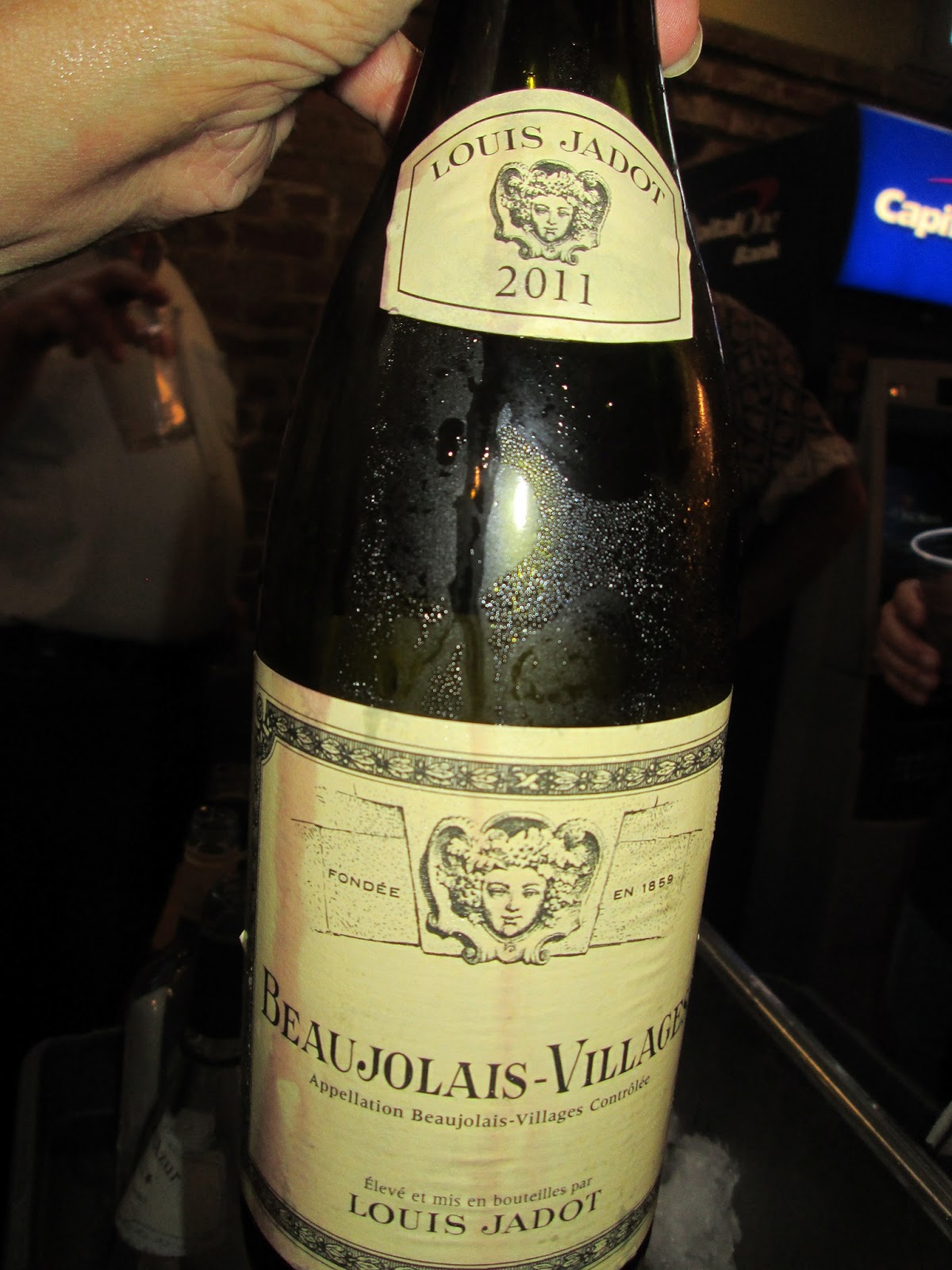
The final selection of the evening was the Louis Jadot Beaujolais-Villages, also served slightly chilled. What can you say about Beaujolais? Light, slightly dry, slightly tannic, and with a long finish. It had just enough fruit to make it palate-friendly, though still not quite what you might consider a social wine.


The following Friday I was back at Swirl. More on that later...

Sunday, May 9, 2010

Bodegas Comenge


The moment I first saw the web site for Bodegas Comenge I knew I definitely wanted to visit there during my time in Ribeira Del Duero. Situated in the province of Valladolid between the sloping terrains of Curiel de Duero and Pesquera de duero, the winery and vineyards encompass a total area of thirty-four hectares (eighty-four acres).

I arrived in Curiel in early April and even though it was a few weeks into spring, the weather was still quite chilly and the vines were all dormant without any leaves. The best time to visit northern wine country in Spain is most likely late August or early September when there are actual grapes on the vines.

When we showed up to Comenge for our 12:30 tour they weren't quite ready to begin and wanted to wait a bit to see if anyone else would turn up. We were told to feel free to walk around the property in the meantime until they were ready to start. I took photos of the vineyards and the town as well as Castillo de Curiel and pretty much everything else in sight.

In front of the winery buildings is a little pond which is home to three white ducks and one very territorial grey goose. When my companion walked over to the pond to get a closer look the goose had come over and made a huge fuss. I started taking pictures and went around toward another side of the pond to get close enough (close being a relative term here) to take some video footage and ended up being chased and attacked by that crazy goose.


Fortunately our guide, Leonor, came out soon after to start the tour of the winery. We began beside one of the vineyards where she explained that Bodegas Comenge currently grows thirty-two hectares of Tempranillo grapes and two hectares of Cabernet Sauvignon which ultimately become their Crianza and Reserva.

Our next stop was in the tank area where the must (grape juice) is first fermented in stainless steel for thirty days and then moved to concrete to better control the temperature of the wine as it develops. From the concrete vats it then goes into oak barrels (French and American) for aging.

Of course there are many things that can ultimately affect what a wine will taste like once it is in the glass but one of the things I learned at Comenge was that the type of yeast used during fermentation (there are a number of possible kinds) is one of the key determining factors. (During this trip I also learned that the word roble means oak.)

From the fermentation area we moved on to the (very cold) room where all of the barrels are kept. I can still smell the faint odor of wood and wine every time I look at my photographs of the barrels. Here Leonor explained that after the initial aging period the wine will be returned to the concrete tanks and reblended before being returned to the barrel once again so that when put into bottles the wine will all taste the same.

After leaving the barrel cellar we moved on to the area where the wine is actually put into bottles. This was our last stop on the tour of the actual production area of the winery. From here we went into another dimly-lit cellar which houses the wine after it has been bottled. In this area we saw rows and rows of large wire-rack cubes stacked from floor to ceiling filled with thousands of bottles awaiting the moment when they would start their destination to someone's table where they would finally be opened and enjoyed.

Bodegas Comenge bottles two red wines and one white. The grapes for both of the red wines are grown on the estates in Ribeira Del Duero while the grapes for the white are grown on a separate property in Rueda because legal restrictions do not allow for the growing of Verdejo in Ribeira.

We concluded our tour in the winery's gift shop . From here we had to go back outside in order to get to another area that would lead us to the tasting room which was located upstairs in a sort of annex at the far end of the building.

The beautifully modern tasting room overlooks the vineyards on either side and has sliding doors which lead onto a small balcony.
Beyond the room are two other areas that serve for dining. I had expected to dine in the winery's restaurant but it did not appear to be open.

For our tasting session Leonor set out a dish of salami, one with shoe string potato sticks and another with a sort of tubular mini bread stick and the wines of course.

The first wine was the Comenge 2009 Verdejo (Rueda). I found it to be "green" on the nose with that vegetal character I usually do not like in a white wine. (I would soon learn why many people identify this aroma as grapefruit) However, I found it to be very pleasant on the palate with nice fruit and none of that green bell pepper essence I had been expecting based on the nose. It was mild with a creamy feel and subtle acidity.

The next wine we tried was the Crianza (100% Tempranillo). It had a nice, rich, toasty nose. I found it to be fruit forward with a long finish that really lingers. It seemed just a slight bit astringent, but not in an unpleasant way. There was some slight bitterness in back with notes of leather, spices and tobacco with very subtle tannins.

The third wine was the Don Miguel Reserva which even though it is labeled as all Tempranillo has about 10% of Cabernet Sauvignon. This one had a great sweetish nose that hinted of vanilla. There was a subtle sense of something sweet on the palate (maybe the vanilla I thought I could smell?) and something aromatic (possibly fennel?) It was a lot heavier bodied than the Crianza and I felt I should have been having some kind of food with it.

All too soon my visit to Bodegas Comenge came to an end.

Saturday, May 8, 2010

A weekend of Wine


It was one of those weekends that was almost non-stop wine tasting. I started out on Thursday at Cork and Bottle for the Rodney Strong meet the winemaker tasting and then the next day I was at Swirl for the return of Free Fridays. Saturday afternoon I met some of the members of the wine meetup at Bacchanal for the first annual Rosé Festival.

What a weekend! Though, actually, I guess I could say I started the weekend on Wednesday since I was at Santa Fe for Cinco de Mayo. I had received a phone call from Carlos the day before asking for help finding music for that evening and made some calls around to the guys I knew (who are mostly Jazz musicians) and lucked out when my friend Detroit Brooks gave me the telephone number for guitarist John Bagnato. I put him in touch with Lale and they worked out the details.

I went by Wednesday night around 8:30 to see how things had turned out and the place was packed! John and Eduardo ended up playing an extra hour. I had a seafood quesadilla and a couple glasses of the Postales Sauvignon - Semillon white. That wine is so pleasant. It has just enough fruit forwardness for it to be social and it's "light" enough to be refreshing in the New Orleans heat and humidity without making you feel like you've been drinking.

Thursday, the Rodney Strong wines were not bad, not great, though I did like the '07 Pinot and the Symmetry Cab blend. Most of them had that toasty vanilla-ish thing going that we've been told is a result of the oak treatment. (More on those later.) I went into Clever after to maybe have a glass of wine after I was done, but the folks I was looking for had already left and there was music starting that didn't really appeal so I went out into the farmer's market. It was winding down by then but I managed to locate Dan Esses and get some fresh spinach pasta (that I almost ruined!) and putanesca.

I don't have a kitchen (still) and I don't know what I was thinking (insert laugh track here); I got home and put some of the pasta in a dish and poured some of the sauce on top and nuked it a bit before I realized I needed to cook the noodles. Of course it was fresh pasta, I got it from Dan! I had to scoop off the putanesca and rinse the noodles and then put them in a pyrex dish and microwave boil them. Surprisingly enough, I didn't ruin them. That sauce was really good too.

Friday at Swirl I got there after six and the tasting was already in full swing. I did manage to beat the crowd and get in all four tastes before the socializing took over but somehow I didn't record both of the reds and now I can't remember what the heck I had that night. (Details below on the ones I did record)

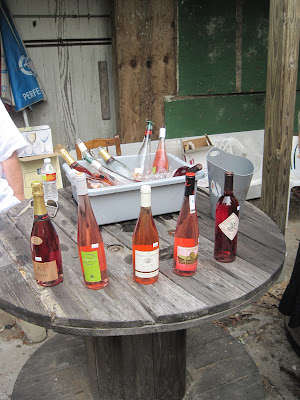
Saturday at Bacchanal turned out to be a blast. Up until now I would not say that I am a lover of rose, but that is because I still think of rosé as what I drank as a teenager. Even now some taste too much like Jolly Rancher candy but then there are others that are really light with floral notes or have almost the same characteristics of Red wines (which really should not be a surprise). Some reds seem to work better than others as rosés and of course climate and location and vinification all play a role. In the last year or two I have been discovering some wonderful rosé wines that I truly enjoy. There is such a vast world of wine and every new bottle is a new journey.

A few photos from Rosé Fest:


I can only hope the rose festival was as much of a success for Bacchanal owner Chris Rudge as it was a pleasure for those of us who attended. (I went back this past weekend for the Spanish whites tasting and purchased a bottle of the Saintsbury; too bad I didn't get two...) I'd had the Postales wines before so I didn't really make notes on them but they are listed below.

So here are the wines of the weekend in order of sampling:

'07 Reserve Chardonnay
Nose: Neutral
Palate: Fruit forward, note of vanila, bright acidity

'07 Reserve Pinot Noir
Nose: hint of dried cherries.
Palate: fruit forward (black cherry?), not too dry, subtle and warm with hint of (green?) tobacco on finish; kind of lingers.

'06 Cabernet Sauvignon Reserve
Nose: fruity, toasty, hint of vanilla
Palate: fruit forward but quickly changes as it moves across; goes from vanilla to dry tobacco-esque to an interesting aromatic herbal quality. Mildly tannic, a little jammy; lingers.

'06 Symmetry Cabernet
79% Cabernet Sauvignon, 10% Malbec, 8% Merlot, 2% Cabernet Franc, 1% Petit Verdot
Fruit forward, hint of vanilla, slightly dry, pleasant and pretty good.

'06 Rockaway Cabernet
97% Cabernet Sauvignon, 3% Malbec
Nose: neutral
Palate: Oak? Sweetish Vanilla


Friday Swirl

Nose: petroleum jelly (slight)
Palate: Fruit forward, pleasant; subtle acidity, citrusy, bright.

Sauvignon Blanc-Semillon
Nose:
Palate: light, refreshing, subtly fruity, perfect for summer.

Cabernet Sauvignon-Malbec
Nose:
Palate: (Didn't record anything)

Cabernet Sauvignon-Syrah
Nose:
Palate: kind of Sweet, toasty vanilla, nice enough

Bacchanal Ros

é Festival


Nick Selby/Uncorked

Dry, crisp

Gurruxtaga 2009
Txakoli Rose
Very light, sharp vegetal tones

Cuvee Les Trois Soeurs
Light, good, refreshing. Has subtle feel of a red.

Light, zesty, pretty pale pink, floral note, nice.

Sangiovese Rose
Light, notes of strawberry, very nice.

Gabe Daigle/Select Wines

Pinot Noir
Interesting; foamy & yeasty

Rosada de Malbec
Nice, light, dry, barely fruity. Drinks like a very light red.

Grenache 58%, Syrah 37%, Mouvedre 5%
Slightly dry, some fruit, drinks like a lightweight red

Adelaida
Pinot Noir
Dry, very much like a red, little green/tobacco; long finish


Mike Procido/Wines Unlimited

Rosado of Tempranillo and Garnacha
Pretty good.

Vin Gris of Pinot Noir
Light, lovely with a slight floral quality

Crios 2009
Malbec
Not bad

Gris de Gris
Grenache gris & noir, Cinsault, Carignan & Mouvedre
Really nice!

George Brown/Vino Wholesale

Cotes De Provence
Absolutely lovely! Delicate and delicious!

Veilles Vignes Bourgogne
(Missed out on this one)


* Recommended

Coming soon... Wines and Food of Spain

Tuesday, March 31, 2009

My First Entry

Welcome to my blog! I spend a lot of time at wine tasting, one of my favorite pasttimes, and people are always asking my opinion about wine so I thought I would start posting my tasting notes online.

Please check back soon for updates.